
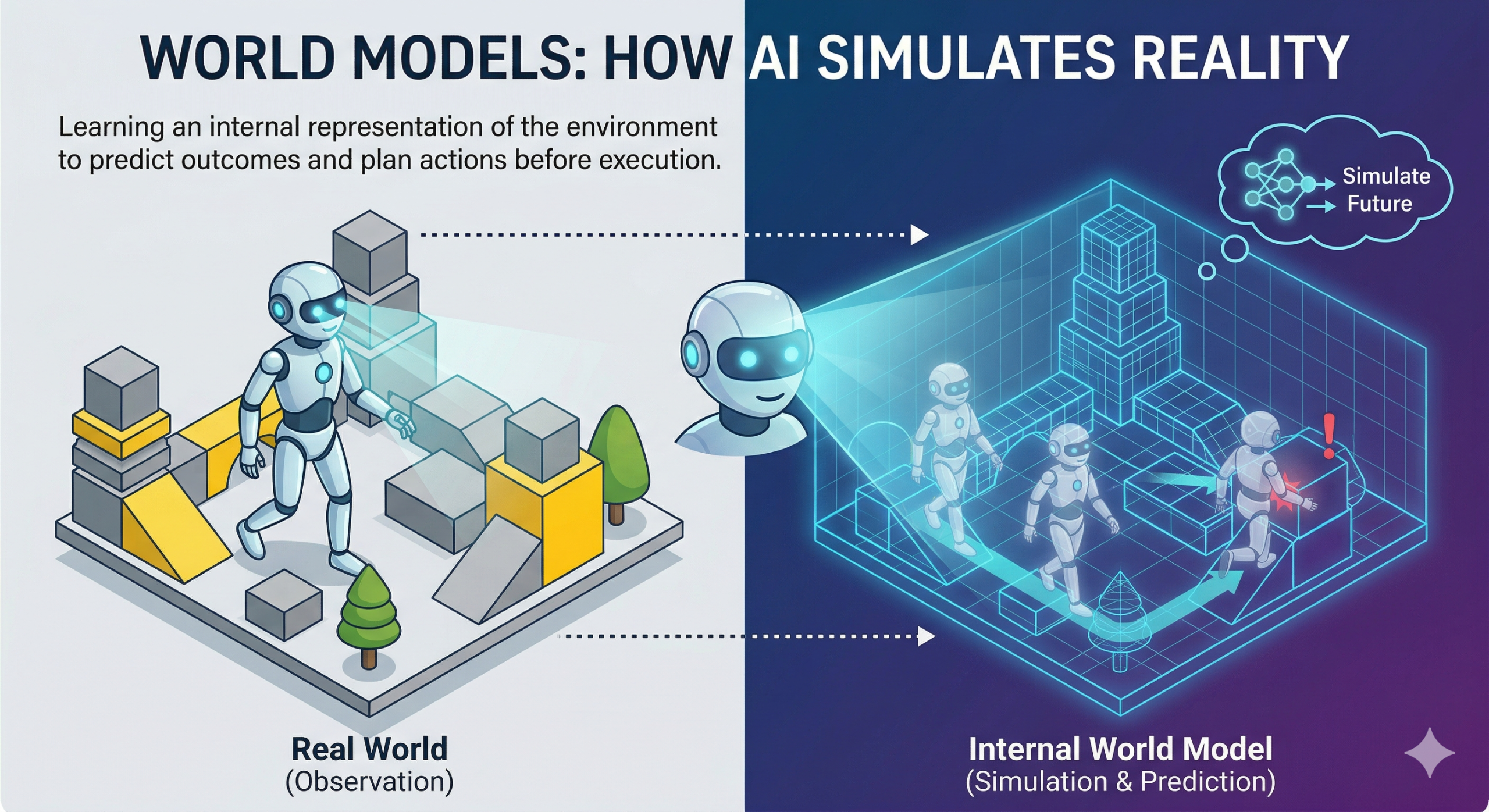
What Is a World Model?
A world model is a type of neural network that understands the dynamics of the real world, including physics and spatial properties. These models can use input data, including text, image, video, and movement, to generate videos that simulate realistic physical environments.
How Are World Models Built?
Building world models for physical AI systems like self-driving cars requires extensive real-world data, particularly video and images from diverse terrains and conditions. Gathering this data demands petabytes of information and millions of hours of simulation footage, followed by thousands of hours of human effort for filtering and data preparation.
Types of World Models
There are different types of world models:
- Prediction Models: These models predict world generation and synthesize continuous motion based on a text prompt, input video, or by interpolating between two images. They enable realistic, temporally coherent scene generation, making them valuable for applications like video synthesis, animation, and robotic motion planning.
- Style Transfer Models: These models guide outputs based on specific inputs using ControlNet, a model network that conditions a model’s generation based on structured guidance such as segmentation maps, lidar scans, depth maps, or edge detection. They can create realistic images by combining different styles of images, such as daytime and nighttime scenes.
- Reasoning Models: These models use reinforcement learning to analyze and reason for themselves before they reach a decision. They can learn from experiences and adapt to new situations, making them useful for applications like robotics and autonomous vehicles.
Key Components
The key components of building world models include:
- Data Processing: Data curation is a crucial step for pretraining and continuous training of world models, especially when working with large-scale multimodal data. This involves filtering out irrelevant data, augmenting the data, and normalizing the data.
- Automatic Speech Recognition (ASR) System: Once data is curated, developers must be able to search through it to find scenarios for specific test cases. The ASR system can help identify relevant keywords and phrases in audio recordings.
- Tokenization: Tokenization converts high-dimensional visual data into smaller units called tokens, facilitating machine learning processing. This allows the model to learn patterns and relationships between different visual elements.
Benefits of World Models
World models extend AI capabilities with deep understanding of spatial relationships and physical behavior in three-dimensional environments. This enables them to simulate realistic cause-and-effect scenarios, such as predicting how objects will move and interact in complex scenes.
Real-World Applications
The real-world applications of world models include:
- Autonomous Vehicles: World models bring significant benefits to every stage of the autonomous vehicle (AV) pipeline. They can generate synthetic data for training perception AI, simulate various scenarios for testing and validation, and predict outcomes based on different actions.
- Robotics: World models generate photorealistic synthetic data and predictive world states to help robots develop spatial intelligence. They can practice tasks safely and efficiently, accelerate learning through rapid testing and training, and adapt to new situations by learning from diverse data and experiences.
- Video Analytics: Trained with rich, multimodal data and advanced reasoning capabilities, world models can perform complex video analytics on massive amounts of recorded and live videos. This enables them to identify patterns and relationships between different visual elements, track objects over time, and detect anomalies.
Reinforcement Learning
Reasoning models use reinforcement learning to analyze and reason for themselves before they reach a decision. Reinforcement learning involves exploring strategies to determine the most effective actions. The model learns through interaction with an environment and receives rewards or penalties based on its actions. Over time, it optimizes decision-making to achieve the best possible outcome.
Optimizing for Efficiency, Accuracy, and Feasibility
Use a reasoning world model to filter and critique synthetic data, improving quality and relevance at speed. This enables developers to optimize their models for efficiency, accuracy, and feasibility. The model can also generate new scenarios based on text and visual inputs, allowing developers to test and validate their models in different contexts.
Conclusion
World models are a powerful tool for extending AI capabilities into the physical world. By understanding the dynamics of real-world environments, they can simulate realistic cause-and-effect scenarios and predict outcomes based on different actions. With their ability to generate synthetic data, reason through complex tasks, and optimize decision-making, world models have numerous applications in industries such as autonomous vehicles, robotics, and video analytics.
Reference
[1] “What are World Models?” NVIDIA. Retrieved from https://www.nvidia.com/en-us/glossary/world-models/